


 Send Inquiry
 Send Inquiry
Screw Press for Sludge Treatment
Price 325000.0 INR/ Set
MOQ : 1 Set
Screw Press for Sludge Treatment Specification
- Dewatering Efficiency
- Up to 99% solid capture rate
- Control Panel
- PLC Controlled with Touch Screen
- Drive System
- Gear Motor with Chain/Belt Drive
- Operating Temperature
- 5 to 40C
- Sludge Type Supported
- Industrial, Municipal, Food Industry, Chemical, Paper & Pulp
- Discharge Type
- Automatic Cake Discharge
- Outlet Cake Moisture Content
- 80% (varies with sludge type)
- Inlet Sludge Concentration
- 0.8% - 4%
- Safety Protection
- Overload & Emergency Stop
- Service Life
- 10 Years (with Proper Maintenance)
- Noise Level
- 70 dB
Screw Press for Sludge Treatment Trade Information
- Minimum Order Quantity
- 1 Set
- Delivery Time
- 2 Week
About Screw Press for Sludge Treatment
Screw Press is designed for efficient dewatering of sludge generated from STP, ETP, and industrial wastewater treatment plants. It continuously separates water from sludge, producing a drier sludge cake while reducing sludge volume and disposal requirements.
Its compact and low-maintenance design makes it suitable for continuous sludge treatment operations, helping improve overall plant efficiency.
Key Benefits
- Efficient Sludge Dewatering: Separates water from sludge to produce a drier sludge cake.
- Reduces Sludge Volume: Minimizes handling, transportation, and disposal requirements.
- Continuous Operation: Designed for steady and automated sludge dewatering.
- Low Maintenance: Simple operation with reduced mechanical intervention.
- Compact Design: Requires less space compared with many conventional dewatering systems.
- Wide Applications: Suitable for STP, ETP, industrial wastewater, and sludge treatment plants.
Advanced Dewatering Efficiency
With up to 99% solid capture rate, this screw press ensures effective separation of solids from sludge, reducing waste volume and enhancing processing efficiency. Automatic cake discharge and customizable capacities support high-throughput operations across diverse industries, saving time and labor on sludge handling.
User-Friendly Automation and Control
Equipped with a PLC-controlled touch screen panel, operators can easily monitor and adjust the process. Automation features, including overload and emergency stop protection, promote safety and minimize downtime, while fully automatic operation simplifies maintenance and routine checks.
Rugged Design for Various Applications
Manufactured from high-grade SS304 or SS316 stainless steel, this screw press withstands corrosive environments, ensuring a service life of up to 10 years with proper maintenance. Suitable for industrial, municipal, and other demanding sludge types, its robust build and horizontal fixed installation offer reliable long-term performance.
FAQ's of Screw Press for Sludge Treatment:
Q: How does the screw press achieve up to 99% solid capture rate?
A: The multi-disk screw press utilizes an advanced screw press dehydration technique that efficiently separates solids from liquids by compressing the sludge between moving and stationary disks. This mechanism ensures a high solid capture rate, minimizing solid loss in the filtrate and improving dewatering performance.Q: What types of sludge can this screw press treat?
A: The device is designed to handle a wide range of sludge types, including industrial, municipal, food industry, chemical, and paper & pulp sludge. Its robust construction and adjustable parameters make it suitable for diverse waste streams and varying sludge concentrations.Q: When should maintenance be performed to ensure optimal service life?
A: Routine maintenance, such as cleaning, lubricating moving parts, and inspecting seals, should be conducted according to the manufacturer's schedule-typically after every major filtration cycle or as recommended in the operation manual. Proper care helps the unit achieve its service life of up to 10 years.Q: Where is the best place to install this sludge screw press?
A: Installation is recommended on-site, in a horizontal and fixed position within wastewater treatment plants or sludge handling facilities. Its compact design allows placement in both new installations and existing setups, wherever continuous sludge processing is required.Q: What is the typical process for sludge dewatering with this machine?
A: The process begins with feeding sludge of 0.8%-4% concentration into the inlet, where it is gradually compressed in the screw chamber. Water drains out through gaps between disks, while dewatered sludge (cake) is automatically discharged at the end, resulting in reduced volume and moisture content around 80%.Q: What are the benefits of using a PLC-controlled touch screen panel?
A: The PLC-controlled touch screen ensures intuitive operation, real-time monitoring, and easy adjustment of processing parameters. It enhances operational safety with features like overload and emergency stop, and streamlines troubleshooting, reducing the need for manual intervention.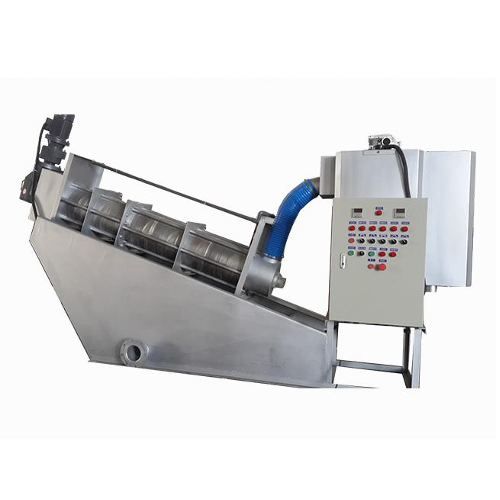
Tell us about your requirement

Price:
Quantity
Select Unit
- 50
- 100
- 200
- 250
- 500
- 1000+
Additional detail
Mobile number
Email


HEAL WATERTECH
All Rights Reserved.(Terms of Use)
Developed and Managed by Infocom Network Private Limited.
Developed and Managed by Infocom Network Private Limited.

